Archive | June 2021

Parading My Pride

NOTE: This piece originally appeared in the June 2009 issue of Q View Northwest, a Spokane, Washington “community newsmagazine celebrating diversity and dances of the human spirit” (sadly no longer in publication).

Those for whom I march
David Weiss, June 2009)

September 2007: “Before we begin this Festival Mass that will open our 2007-2008 school year, we invite you to turn to the person next to you to introduce yourself and greet them,” said the worship leader.

I was at the back of the large church sanctuary, standing in the center aisle, in my black master’s academic gown, with my red velvet hood, denoting my degree in theology. It was the start of a new school year at the Catholic college where I (at the time a Lutheran) worked in campus ministry. My job was to signal the start of a very formal festive procession down the aisle, making sure that each person was paced appropriately.

I turned to the young woman standing next to me in the aisle, our Student Senate president. Claire, attired in her own black gown, was first in the procession, carrying a college banner. I knew her name from the worship folder only; we’d never met. “Hi,” I said, “My name is David, I work in campus ministry.”

Claire smiled brightly and said, “I’m Claire, and I know who you are. This past summer I was at the Twin Cities Pride Parade with some of my friends. As we were watching the parade you walked by with your church, and I recognized you as being from our college. One of the friends with me had you for a class and told me who you were. David, it brought tears to my eyes to know there was a straight man from my college marching in our Pride Parade!” And her eyes welled up again with gratitude.

Then the music started, I watched for my signal from the choir director, and I sent Claire marching down the aisle, both of us – the straight Lutheran man and the lesbian Senate President – finding our most powerful moment of grace in the eyes of each other quite before Catholic Mass had even started.

I learned a powerful lesson that day.

I’ve marched with my Lutheran church (part of a larger contingent of about 30 Lutheran churches that are represented at Twin Cities Pride) for several years now. Mind you, like many writers, I have a pretty close relationship with my introversion. Marching for a mile and a half down a gauntlet of crowded sidewalk (we have 125,000 people turn out for our parade!) – even if the crowds are cheering those of us who march – well, it’s not exactly my cup of tea.

So as I march my introverted self down the street, besides alternately holding my wife’s hand, helping to carry our church’s banner, and practicing my best “Miss America” wave, I steady my nerves by reminding myself of those for whom I march. It is not a short list. I call to mind the faces of friends, like Dale, who died without ever finding a spiritual home to embrace them. And the faces of others who are still wrestling to find peace with their twin impulses of sexual and spiritual longing. And the children of same-sex couples that I’ve taught in Sunday School. And the many friends who share the pews with me at church on Sunday mornings. And the college students I’ve met through my teaching and work in campus ministry. When I march I hold lots of faces in my mind and heart.

But this is what I learned from Claire on that day in September 2007. I also march for persons I don’t know. I march to be seen by someone like Claire, whom I’d never met at the time, but whose journey became a little easier and whose day became a little brighter because she saw me.

Marching in our pride parade is hardly the biggest thing I do as an Ally, but for Claire, in June of 2007, it was pretty significant. And this year, when I march again, Claire’s shining smile will be one of the faces I have before me. But thanks to her, I’ll also be a little more comfortable marching my introverted self down that street, because I’ll remember that maybe this year, too, there will be someone watching, someone that I’m not even thinking of yet, who will be happy to see me there.

* * *

David Weiss is a theologian, writer, poet and hymnist, doing “public theology” around climate crisis, sexuality, justice, diversity, and peace. Reach him at drw59mn@gmail.com. Read more at www.davidrweiss.com where he blogs under the theme, “Full Frontal Faith: Erring on the Edge of Honest.” Support him in writing Community Supported Theology at www.patreon.com/fullfrontalfaith.

Braiding Sweetgrass … with Jesus – #1

Braiding Sweetgrass … with Jesus – #1
David R. Weiss – June 23, 2021

Prodded by my pastor (to whom I now owe a debt of gratitude … thanks, Sarah) I finally pulled my copy of Braiding Sweetgrass off the shelf and started reading. The author, Robin Wall Kimmerer, is a member of the Citizen Potawatomi Nation and a botanist, and her book is subtitled, “Indigenous Wisdom, Scientific Knowledge, and the Teachings of Plants” (Milkweed Editions, 2013). Her work straddles worlds and worldviews, weaving together story and wisdom and science, braiding them … like sweetgrass.

Kimmerer notes that while it’s possible to braid sweetgrass by yourself, “the sweetest way” is to work in tandem with someone else, “so that you gently pull against each other, all the while leaning in, head to head, chatting and laughing” as you braid. (ix) That’s how I tend to read most everything: leaning into the words and wisdom of others and chatting amiably as I join the conversation as a theologian determined to learn as much as I can and discover connections wherever possible.

I’m not interested in co-opting Kimmerer’s work or indigenous wisdom in general. Her writing sings with an authenticity and eloquence that is all her own. I am, however, interested in placing my Christian tradition in vibrant conversation with other streams of sacred (and scientific) insight. There is just too much truth for us not to share its abundance—and too much at stake for us not to bring fresh wisdom home every chance we get. So this is me … braiding sweetgrass … with Jesus.

(I’m not sure how many of these posts I’ll write. I don’t plan to offer a page-by-page or point-by-point commentary. I simply want to lift up some of the places in Braiding Sweetgrass where I found myself lifting up my eyebrows in kindred recognition or in appreciative insight.)

Ceremony, memory, story (pages 5-8)

Kimmerer writes, “Our elders say that ceremonies are the way we ‘remember to remember.’” Ways that we are called to reenact memories that true our lives. And so it is. I would add—and Kimmerer would heartily agree, they are, in fact, the way we remember to remember to re-member.

In the Protestant church we have two great “ceremonies,” rituals we call sacraments: baptism and communion, although throughout our liturgical year the various feasts and festivals and seasons we observe also are focal points of remembering. But let’s take just baptism and communion. These rituals connect contemporary action to ancient promise and do so through by placing our lives into the deep story of our tradition’s origins. Our elders (saints and theologians) say that these rituals announce grace at the core of our living. This truth embraces us in every moment of our life, but the ritual gives us a sacred choreography that reminds us—tactilely, tastefully—to remember that truth so vividly that it follows us from ritual moment to mundane living.

Luther said that Christian life is a daily crawling back to our baptism. The water wets us but once, though we join in wetting others and recall our own baptism each time. But the truth of the water is not held fast by the font; it splashes outward into our waking and sleeping and all the breaths we take in between. And our communion liturgy, of course, reminds us that Jesus himself said, “Do this to remember me.”

In our sacred ceremonies as in the ones that Kimmerer recalls, the truths are remembered not simply by proclamation but by story. The power of such ceremony is not “magic”; no matter how enthralling Harry Potter tales might be, we are not playing at wizardry here. Ceremony moves memory, and memory holds story, and story holds truth, and truth opens to power. For us, grace—the audacious and exquisite knowing that we are loved by divine abandon—dances in both directions across these connections, ultimately bearing fruit in lives ripe with love.

But we don’t simply remember to remember, but also to re-member. Which is to say by these rituals, we re-kin ourselves one to another. We too easily take this for granted. But the truth and power of grace is always communal. We are never saved-loved-healed singly, even though there are absolutely moments in which we experience it as such. Still, the Wisdom that fashioned the fabric of creation wove it socially, from gravity to ecosystem, tectonic plates to human community. Those who have been marginalized, excluded, or condemned by wicked twists in the tradition on account of gender, ability, race, or sexuality, these ones can attest to the rampant joy of being enfolded by sacred ceremony, being named within holy story, being re-membered into true place, being heralded home.

If our present experience of baptism and communion seems tepid by comparison to the rich imagery evoked by my braiding sweetgrass … with Jesus, we might ask ourselves how we can re-animate our ceremonies so that they indeed become holy moments in we remember to remember to re-member … grace.

* * *

David Weiss is a theologian, writer, poet and hymnist, doing “public theology” around climate crisis, sexuality, justice, diversity, and peace. Reach him at drw59mn@gmail.com. Read more at www.davidrweiss.com where he blogs under the theme, “Full Frontal Faith: Erring on the Edge of Honest.” Support him in writing Community Supported Theology at www.patreon.com/fullfrontalfaith.
This entry was posted on June 24, 2021. 2 Comments

Hearts: Hardened … and Softened

Hearts: Hardened … and Softened
David R. Weiss – June 22, 2021

I occasionally write for The Word in Season, a daily devotional published by Augsburg Fortress. A set of my devotions, spanning June 17-30, are in the current quarterly issue. Today’s (6/22/21) is based on Exodus 9:13-35 (I don’t pick the texts; they’re assigned to me). In the passage Moses, speaking for God, tells Pharaoh to let the Israelites go. When he refuses, a plague of hail comes, after which he relents—but immediately changes his mind once the hail stops. This was my devotion:

Title: When past becomes present
Key verse: So the heart of Pharaoh was hardened, and he would not let the Israelites go. (v. 35)

It’s not just Pharaoh’s heart; this text is hard, too. From start to finish, God’s demand is met only by Pharaoh’s stubborn resistance. It isn’t easy to find any good news, because this passage ends chapters before any real liberation happens. So here’s an equally hard devotion to go with it. God used Moses’ human voice to declare “Let my people go.” Today, through equally human voices, God declares “Black Lives Matter.” But our society, too, is chapters away from any real liberation. Systemic racism has put generations of Black persons in societal bondage as effectively as Pharaoh’s system of slavery. Who but God would have the audacity to say on their behalf, “Let my people go”? And I squirm. Because in our society I’m far closer to Pharaoh’s officials than to the Hebrew slaves. But God’s declaration, today, is no less divine demand: “Black Lives Matter.” Can my heart be softened so that I join in working for their liberation?

Prayer: O Savior of slaves, make me an accomplice in your work for liberation. Amen.

Photo by Chris Henry on Unsplash

I heard from two readers today by email. One wrote, “I was shocked beyond words when I read your devotion this morning. To say “God is declaring that Black Lives Matter” and comparing it to Pharaoh’s system of slavery is way beyond any truth or fact and is certainly not a good comparison. You obviously haven’t done any research on the BLM organization, who runs it, what their goals are and what they stand for and how it is funded. One of their goals that you should be aware of because it made national news here in the Twin Cities is they want to kill police officers and burn their bodies (“Kill the pigs and fry them like bacon”). Do you believe God is demanding that?! You must believe and serve a different God than I do. I cannot believe a Christian writer would write such a claim.” Hmmm, sounds like someone woke up with a hardened heart.

As it says in Exodus 14:32-33, “And the people sang, ‘We crossed the sea on a dry, dry bed, but Pharaoh’s police are wet, wet, dead. They chased us while the waters seethe; now look who crying “I can’t breathe.” Edgy? You bet. (Also, made up. Chapter 14 ends at verse 31.) But the human hunger for freedom and dignity is as powerful as any force in the world, and it will find expression, even if it offends the propriety of the powerful.

Another reader wrote, “Today’s Word in Season devotions, drawing the connection between Moses imploring the pharaoh to let my people go, and Black Lives Matter—simply amazing! I have not read such a strong and compelling devotional piece in these pages that I can recall. My deep thanks! You rock!” Well, poetry rocks and God rocks. I just stand at the crossroads and call out the connections as I see ’em.

As I noted when I passed the messages along to my editor: “Seems my words struck home with each reader in any case. The rest is up to God.” Actually, the rest is also up to me. I’m in this for the long haul. And while I won’t soften every heart (and I may harden a few here and there), my goal is to bear faithful witness to the God who seeks justice for all of us. And that prayer I wrote—you’re welcome to pray it, too, but those words are my plea for a heart softened and more: O Savior of slaves, make me an accomplice in your work for liberation. Amen.

* * *

David Weiss is a theologian, writer, poet and hymnist, doing “public theology” around climate crisis, sexuality, justice, diversity, and peace. Reach him at drw59mn@gmail.com. Read more at www.davidrweiss.com where he blogs under the theme, “Full Frontal Faith: Erring on the Edge of Honest.” Support him in writing Community Supported Theology at www.patreon.com/fullfrontalfaith.

This entry was posted on June 22, 2021. 1 Comment

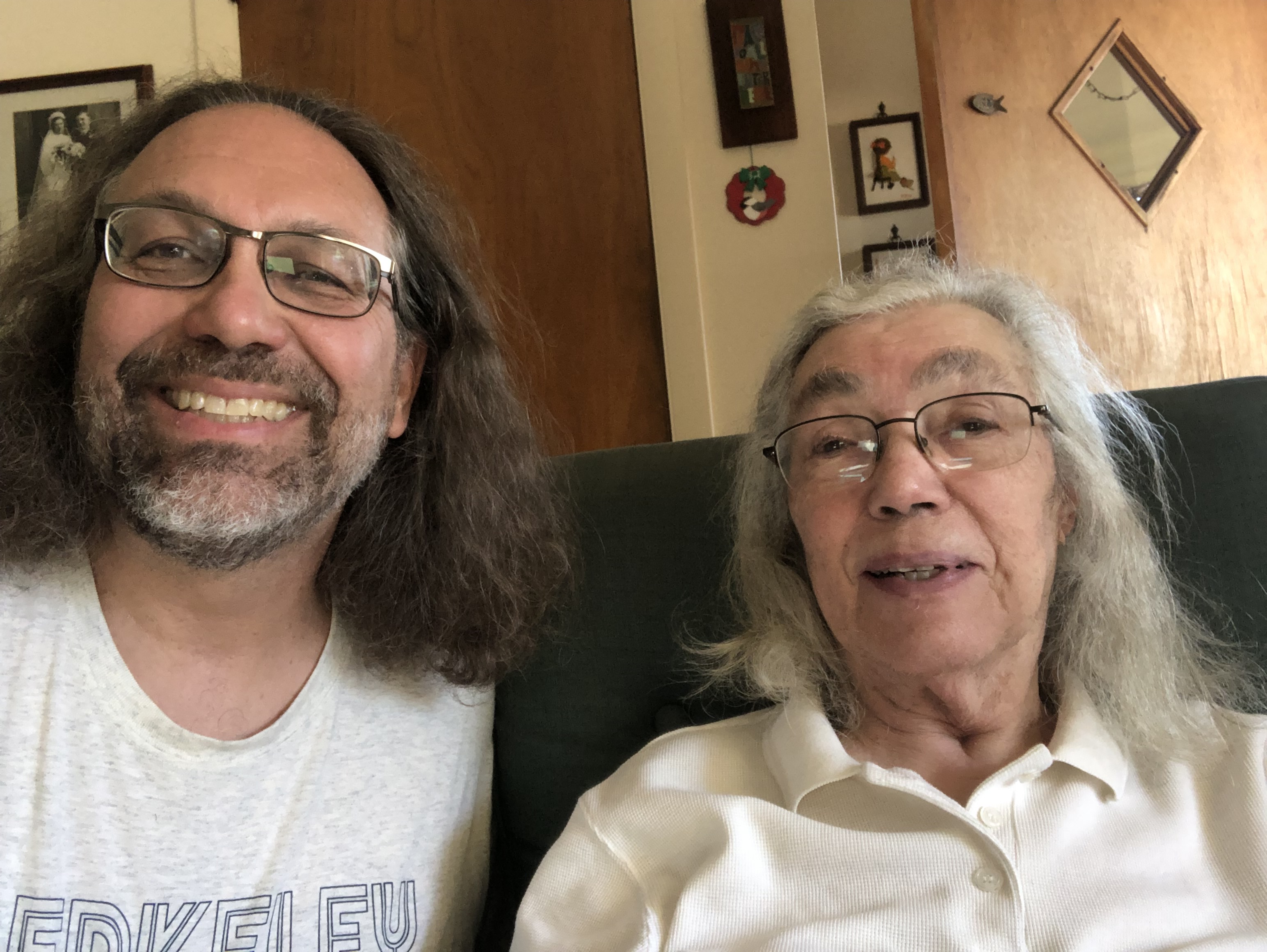
Me and Mom

Note: I shared this on Facebook the night I wrote it; am sharing it here fir those who aren’t on Facebook or may have missed it there. My mom has been dealing with memory loss and encroaching dementia (likely Alzheimer’s) for several years now. Looking back, my dad would say she began deteriorating over a decade ago. She turns 87 this summer. Because I hadn’t seen her in ten months due to Covid, the changes in her behavior, memory, and affect were pretty stark.

Me and Mom

For so many years
we spent so many hours
late into the night
talking from here
to kin-dom come
about dreams and hopes
and heartbreak.
Yours the ears that
heard me into speech;
yours the heart that
held me (and Dad) close
when the chasm between
us—me and Dad—
seemed immeasurable.
Today when I arrived
there was no hug,
no tender kiss
to welcome me
as usual.
Nothing is usual anymore.
You asked
where I had come from,
not remembering
I live in Minnesota;
and if I was staying for supper,
not realizing
I’m here for 3 days;
and if I was married,
no longer knowing
the grandchildren
I’ve given you
or the woman
whose life and love
I’ve shared
for 20 years now.
Home is bittersweet joy,
but
I am still the luckiest boy
I know to be able
to call you, Mom.

2021.06.16

Me and Mom – June 2021

This entry was posted on June 17, 2021. 4 Comments

When the Center Slides Sideways

When the Center Slides Sideways
David R. Weiss – June 15, 2021

NOTE: This post, which discusses my “complicated relationship” with myself (depression), isn’t about seeking pity, much less attention. I rarely go “here” in my public writing. Of course, there’s shame, embarrassment, and self-consciousness at play. But also, as a writer, I harbor a deep desire to be known for the inspiring, piercing, provocative words I write rather than the cacophony of voices (a virtual chorus of inward critique and cosmic nihilism) and bewildering feelings (and sometimes the sheer absence of feelings) inside me.

ALSO: Although this should go without saying, I will say it—just in case. Expressions of solidarity, appreciation, insight, are welcome. Unsolicited advice is not. This is my life. It has been my life at least since adolescence. Over the years I’ve worked with several therapists, and I’m actively working with one right now. I’m processing some of my stuff out loud today, not so you can tell me what you’d suggest, but so you can better understand the ebb and flow (some days the pathos and chaos) of my inner life. If that’s TMI—“too much (personal) information”—for your tastes, just wait for my next post. I don’t come here often, but sometimes the better part of valor is actually less discretion. That’s my choice today.

*          *          *

There’s a challenge of living with chronic melancholy (mild/moderate depression) on top of being both intellectually thoughtful and temperamentally introverted. It’s easy for others to mistake my more or less level demeanor as inner calm, when it’s just as likely to be existential weariness. The quietly desperate attempt to find bearings that mark meaning and purpose in a world that seem determined to undercut both of them regularly. And, for me, acutely.

This spring my center unexpectedly slid sideways and that weariness ate me alive. Somedays for breakfast, lunch, and supper. And not because of any one thing. Sometimes life is hard for me even on days when I channel joy. That’s perhaps one of the most damning details about depression: joy takes the edge off it—and thanks to family, friends, and trees—I am fairly pampered with joy. But it is no cure for it. And the melancholy that lives in the marrow of my bones never takes a vacation.

On the other hand like noxious algae in a lake, it does occasionally … bloom. And when that happens—holy shit—all the oxygen in the lake gets gobbled up and I’m left gasping for air … that simply isn’t there. In the very place I like to call home. ME.

There is no clear cause or specific reason to point to. Whence this sadness? Were I more dramatic, I might make a wild sweeping gesture and say, “All of this! All. Of. This.” As a poet-prophet-essayist, my bread and butter is empathy plus vulnerability plus holding myself open to unexpected insights that are as likely to rock my world as yours.

That set of peculiar characteristics forms the cauldron in which my words bubble away. But when the center slides sideways I can lose my balance and suddenly—oops—find myself dunked into that cauldron, too. For no good reason at all (it’s not like anyone—or anything—pushed me) I’ve spent most of the spring with my psyche simmering alongside all the other muck in my own cauldron pitched over the fire that burns in my soul. I’ve been so busy treading “water” inside a fairly toxic brew of social perceptions that I can barely fashion a coherent sentence before I feel myself being pulled under again. Which is why my blogging has been so sparse of late.

Make no mistake, this sludge is (potentially) as creative as it is toxic … and (potentially) as lethal as it is lively. So I do still turn out some sparkling pieces: a couple hymn texts and essays come to mind. The hymns in particular garnered me some fine praise. And they are textual gems. Glistening, powerful. But alongside those accolades comes a measure of loneliness.

Photo by Petr Slováček on Unsplash

Full disclosure: I exist, day-to-day, far closer to the edge of despair and madness than most everyone (except maybe Margaret) realizes. It’s fair to liken this past spring to me doing a free solo climb on the sheer face of a mountainside cliff. I don’t exactly mind. I mean, I always hoped for a sense of vocation that would bring me fully alive. I suppose it’s just quibbling to add with some irony that at times it nearly kills me as well. Whatever.

But please be cautious—generous but cautious—in your praise. Because you see me—when I post the final product on my blog or on Facebook—crest the cliff edge and hoist myself and my words onto the top, and it looks (and I even feel) celebratory. But while no one was watching this past spring I nearly lost my grip on that sheer face of the cliff umpteen times. Sometimes amid the writing itself; more often amid the inner writhing that made the writing so difficult.

Nonetheless, I truly believe I’m called to this restless existence. I might even say sadness is my superpower. Or at least my capacity to fashion something precious out of the melancholy that marks my mood more days than not. This is not wallowing. You and I both need the gifts I bear. And while there are things I can do—and do better—to maintain my balance (and avoid taking foolish risks on that sheer face of the cliff) there is no path for me that is not perilous.

I am (simply) doing my work in the world. And the conditions in which I do that work are intrinsically dangerous. But so are the conditions in which one fights wildfires, and no one says those who fight them are foolishly tempting death. They’re taking risks to honor life. Those who know me, know that I am no thrill seeker. Far more kin to Bilbo Baggins than Aragorn, if I’m laboring in deep peril, it’s because I don’t believe there are other conditions in which this most important labor (call it truth-telling for church and society) can be done well.  

Still, this spring (really for the first time in three years—and for no real good reason at all) my center slipped sideways, I lost my balance, and I found myself gasping for air. I’m breathing a little easier these days, although I still haven’t quite re-centered myself.

I find life harder that you might guess. Even on good days. And especially on bad ones. But when I write, that’s when the magic happens—that’s when I feel most fully alive. If I make it look easy, that’s only because writing settles my soul. Rest assured, the Wind was howling and the Water was pelting me before the words came.

No complaints. It’s just time to be known on my own terms.

*          *          *

David Weiss is a theologian, writer, poet and hymnist, doing “public theology” around climate crisis, sexuality, justice, diversity, and peace. Reach him at drw59mn@gmail.com. Read more at www.davidrweiss.com where he blogs under the theme, “Full Frontal Faith: Erring on the Edge of Honest.” Support him in writing Community Supported Theology at www.patreon.com/fullfrontalfaith.

This entry was posted on June 15, 2021. 6 Comments

Jeff Bezos and the Overview Effect

David R. Weiss – June 11, 2021

God loves Jeff Bezos. And: Jeff Bezos’ life choices constitutes a remarkable series of choosing evil over good again and again and again. And again. These things can both be true. Indeed, they are.

Few persons alive on the planet today, politicians or magnates, have so hoarded power and wealth at the expense of so many and at such dire cost to the planet, as Jeff Bezos. His very modus operandi is to exploit workers and undercut other businesses so as to maximize profit as though he were a cancer. If we’re honest (and it’s time to be honest), the man has a pathological obsession with wealth that ought to be criminalized because of the social and ecological harm it actively causes.

So, excuse me if I’m unimpressed by his plans to launch himself into space next month.

“The Blue Marble” – Earth from space – image from NASA, Apollo 17, 1972

He remarks in a recent Instagram video that going into space has been a childhood dream of his. That’s likely true for almost every Amazon worker whose slow impoverishment has been crucial to Bezos’ wealth. Then he says, “You see the Earth from space, [and] it changes you. It changes your relationship with this planet, with humanity.”

Nope. Nope. Nope.

Sorry, that’s NOT how it works. The “overview effect,” as it’s come to be known, refers to the transformational shift in perception reported by many astronauts as a result of spaceflight in which they have seen Earth whole and fragile, its collective vulnerability (our collective vulnerability) shimmering in space.

But Bezos has spent his adult life not merely insulating himself from collective vulnerability—he’s actually devoted his business model to exacerbating it. And in that case that is ZERO reason to think he can glibly—as a stroke to his narcissistic ego—jet off into the deep blue on a lark and gain enlightenment.

I call bullshit. Not because I’m mean spirited but because that’s the gospel truth.

Consider Jesus’ parable of the Rich Man and Lazarus (Luke 16:19-31). The rich man, sometimes named Dives (which is simply the Greek word for “rich man”) feasts sumptuously day in and day out while Lazarus goes hungry outside his doorstep.

When both men die, Lazarus is carried off to Abraham’s bosom, where he is at last comforted. Dives, meanwhile, finds himself in the fiery torment of Hades. From there he begs Abraham to send Lazarus back from the dead to warn his brothers that they might change their ways. Abraham reminds Dives that they already have Moses and the prophets (that is, the rich social justice teaching of the Jewish tradition) to guide them.

Dives protests, “But if someone goes to them from the dead, they will surely repent.” To which Abraham responds (but remember, this is Jesus’ parable), “If they won’t listen to Moses and the prophets, neither will they be convinced even if someone rises from the dead.” Not even if someone launches themselves into space.

I don’t doubt that the overview effect is real, but for someone so existentially (and economically) invested in rejecting it, someone leveraging the obscenity of their wealth to purchase it (!), the overview effect will prove far more elusive than a mere space flight. As Jesus advised another rich man (Mark 10:17-31), Bezos would be wiser to sell what he owns and give the money to poor. Short of a willingness to do that, his space flight is just another fool’s fantasy. As well as an assault on the poor … and on the planet.

* * *

David Weiss is a theologian, writer, poet and hymnist, doing “public theology” around climate crisis, sexuality, justice, diversity, and peace. Reach him at drw59mn@gmail.com. Read more at www.davidrweiss.com where he blogs under the theme, “Full Frontal Faith: Erring on the Edge of Honest.” Support him in writing Community Supported Theology at www.patreon.com/fullfrontalfaith.