Archive | July 2021

An Abiding, Enduring Vocation: Delivering Dark Hope #4

An Abiding, Enduring Vocation: Delivering Dark Hope #4
David R. Weiss – July 29, 2021

NOTE: I am writing for my life—and for yours. Modest regular support for my writing (even $2-10/month!) via Patreon not only keeps me fed, it’s also a huge emotional-spiritual boost, letting me know my words are valued. None of my writing behind a pay wall. It’s all gift. Over the next decade it may be among the most important gifts you receive. If you can support me with a monthly gift I’m grateful. In any case, please read—and please subscribe.

*           *           *

This is #4 in an eight-essay series written over ten days in which I’m thinking out loud and a bit on the run about what it means to be church (or any authentic human community) … in a time of approaching ecological-social collapse. I’ll develop many of these thoughts further in the future, but I want to set out an overview of sorts. (Here are links to essay #1, essay #2, and essay #3; while each essay treats a different facet of the larger project, there is a narrative arc to them. I encourage you to read them in order when possible.)

*           *           *

After two essays on collapse, it’s time for some hope. But not just any hope; dark hope.

Why Dark Hope? I’m trying to frame a “hope” that is decidedly not “upbeat.” Because hope in its “upbeat” tone is too close for comfort to foolhardy optimism, which is, in turn, too close for comfort to sheer arrogance, both of which have played a prime role in fostering the collapse that is coming for us. Even more pointedly, though, I say Dark Hope because we’ll need a hope that is fully alongside us in the unpredictable tumult ahead. Not a hope that says, “keep your chin up” or “hang in there,” but a hope that gasps with us: “breathe!” Indeed, not a hope that shines in the darkness, but a hope that abides as darkness itself. I’ll write a longer piece on this, but that’s a start.

But first, a little more on collapse … because today, July 29, 2021, is World Overshoot Day 2021: the day when, as a global community, we’ve used as many resources as the planet can generate in a year. In other words, for the remainder of 2021, we’re stealing resources from future generations. In the late 1970’s, when we slipped into overshoot in late December, it was the first time—in the history of forever—that humanity as a whole had outstripped Earth’s abundance. Since then, we’ve rolled that date back by five months. Now we enter overshoot in July.

But July 29, 2021 is World Overshoot Day. Not all countries use their share of global resources at the same pace. Here in the United States, we blew by our Country Overshoot Day … all the way back on March 14. We’ll spend the last 292 days of 2021 draining off the life of future generations. Did we really think that Mother Nature wouldn’t notice?!

This is why ecological and societal collapse is inevitable. Because we have made overshoot into the very infrastructure of our culture. It is the means by which we’ve come to manage the trauma of our mortality (see essay #3). The rising CO2 levels that drive climate change are “merely” symptomatic of our cultural addiction to an extractive economy now wedded to ecocidal consumption amid psychic denial. But now collapse is coming.

Which is why we must turn swiftly to “Deliver Dark Hope” for the days to come.

Honestly, in the worst-case scenario (and there are more persons than you might guess who foresee a worst-case scenario), the cascading effects of climate change and loss of biodiversity integrity (basically rupturing ecosystem after ecosystem) will be so severe that humanity as a species will not survive the next 100 years. That’s a worst-case scenario, but it is NOT an inconceivable one. Were it to come to pass, the last human being to ever live might already have been born. Worst-case scenario, but conceivable. Sit with that awareness for a few days.

Personally, I still think a best-case scenario is possible: one where over the next 20-40 years we experience a series of jarring lurches backward in development as agricultural, political, electrical, civic, medical systems and more are upended by a world running on overshoot far too much and far too long. Any projection of a smooth, technologically guided draw-down strikes me as dangerously naïve.

Mathematically, the Minnesota Twins (currently 17 games out of first place, with a record of 43-60) could still come back to win their division. But only a fool would bet money today on their World Series chances this year. And only an addict would bet the life savings of their entire family on that prospect.  

Right now our entire culture is drenched in addictive consumption—this is true to varying degrees across almost every demographic. Which is why even the level-headed climate pundits preferred by the mainstream media are able to keep telling us, “It’s bad, but there’s still a chance to make this all right.” My brother, who died after a decades long battle with alcoholism, believed right up until his last drink, that there was still a chance to make this all right. I’m telling you, that type of talk simply encourages addicts of all stripes—including lots of folks of good will—to bet the entire welfare of the next generation on the tiniest mathematical possibility (one that nothing in all history says is possible): “we can still make it all right.”

Collapse is coming. And it will be chaotic, brutal, deadly, and apocalyptic in ways we’ll wish happened only on the movie screen … or in the Bible. Still, in a best-case scenario—the one with multiple jarring backward lurches—if we brace for collapse and if we prepare ourselves and one another to endure, we may persevere. Which brings me to Dark Hope.

In 1939, Lutheran pastor and theologian Dietrich Bonhoeffer accepted an invitation to come to Union Seminary in New York. Already fiercely critical of (and targeted by) Hitler and the Nazi regime, the invitation offered him safety on the eve of the Second World War. But soon after arriving he changed his mind—despite strong pressure from many friends to remain here. He explained that he needed to return to be with the German people in order to be worthy to participate in rebuilding their life after the war. Bonhoeffer’s conviction became clear and unwavering: he was called to be with his people in the midst of tumult. His vocation was to embody Emmanuel—“God-with-us”—for his community.

Today, for the church to deliver Dark Hope—to bear good news in the very belly of the beast that is collapse—we must be equally clear and unwavering. We dare not hold on to the safety of “calm” until it is too late to bear witness at all. Like Bonhoeffer, our calling is to be God’s presence in the midst of God’s people … in the midst of collapse. That begins by having the conviction to be public in acknowledging that collapse is coming. Avoiding it is no longer possible. Hoping otherwise is no longer justified. And waiting even a little longer to see what comes our way risks choosing timid caution in a moment that requires daring faithfulness.

That moment is now. If we are to have a harvest of Dark Hope ready for when our people need it, we must begin planting those seeds today.

There is still more to say about Dark Hope, and I will say it briefly in the days ahead … and at length in the months and years to come. If you’ve come with me this far, thank you. Here’s where we have yet to go.

Sunday: My assertion that Dark Hope admits the impending reality of collapse is NOT a cry of resignation. It is a call to action oriented toward the truth. There remains quintessential, even existential value to justice work. This is true even and especially in a world that’s unraveling. Stopping pipelines, honoring Black Lives, abolishing prisons—this work becomes all the more imperative in a world misshapen by climate breakdown.

Monday: The shape of Christian faith (actually of human faith) in this time of Dark Hope will be steeped in lament-compassion. But there are other key virtues to be cultivated as well, such as the gratitude, awe, widened kinship, mutual service, and healthy humility mentioned yesterday. This is a twin summons that involves both reclaiming core features of our distant heritage and imagining new ways to cultivate and practice them in a wholly changed world.

Tuesday: This will be the most difficult piece for me to write (and the one I am least prepared for). I will offer some first thoughts on how Dark Hope honors our children and grandchildren as the blessing they are, within the agonizing recognition that their inheritance from us … will be collapse. How then will we love these lives that have already been consigned to such jeopardy? I don’t yet know, but I will learn.

Wednesday: This much I do know, even though I cannot say how: Dark Hope brings with it joy. There is much that we will not fathom in advance—we will only understand in the doing, but I believe compassion is the alchemy of human existence. It is the seed of the sacred in our lives. And its fruit is joy.

And now, a short break from these essays to prepare a sermon. I’ll be “back” on Sunday. I hope you are, too.

*           *           *

David Weiss is a theologian, writer, poet and hymnist, doing “public theology” around climate crisis, sexuality, justice, diversity, and peace. Reach him at drw59mn@gmail.com. Read more at www.davidrweiss.com where he blogs under the theme, “Full Frontal Faith: Erring on the Edge of Honest.” Support him in writing Community Supported Theology at www.patreon.com/fullfrontalfaith.

This entry was posted on July 30, 2021. 5 Comments

Collapse: The Psychic-Social-Cultural Roots: Delivering Dark Hope #3

Collapse: The Psychic-Social-Cultural Roots: Delivering Dark Hope #3
David R. Weiss – July 28, 2021

NOTE: I am writing for my life—and for yours. Modest regular support for my writing (even $2-10/month!) via Patreon not only keeps me fed, it’s also a huge emotional-spiritual boost, letting me know my words are valued. None of my writing behind a pay wall. It’s all gift. Over the next decade it may be among the most important gifts you receive. If you can support me with a monthly gift I’m grateful. In any case, please read—and please subscribe.

*           *           *

This is #3 in an eight-essay series written over ten days in which I’m thinking out loud and a bit on the run about what it means to be church (or any authentic human community) … in a time of approaching ecological-social collapse. I’ll develop many of these thoughts further in the future, but I want to set out an overview of sorts. (Here are links to essay #1 and essay #2; while each essay treats a different facet of the larger project, there is a narrative arc to them. I encourage you to read them in order when possible.)

In communities of faith—as well as in visionary humanist communities—we tend to hold the conviction that somehow … God, widespread political-personal activism, strategic nonviolence, contagious goodwill, inspired community … can still turn things around. Yet, for the past fifty years almost every reputable “hard science” report has told us, if we hope to live long on this planet we have to start taking better care of it—and soon. Even in recent years, as the reports have grown more and more alarming, most still close with an obligatory paragraph that says, “But there’s still time—if we act soon enough.” There are reasons for this persisting optimism, but the hard science (see essay #2) is not one of them.

Neither is the soft science. We can document fifty-plus years of doing as little as possible—and oh so begrudgingly. The history of climate policy, corporate priorities, and personal behavior does not inspire hope. Except for exceptions (which prove the rule), no one seems ready to believe that these calls to action apply to them. But what explains our collective inaction that seems all but certain to prove deadly?

Here’s one piece that holds explanatory power.

Death: it’s killing us. It’s more complicated than that—but let me explain. Watching those who stormed the Capitol on January 6 in a frenzy of insurrectional violence I was struck by both their anger and what I took to be their fear. I recalled an image used by Canadian theologian Douglas John Hall in his book, Lighten Our Darkness (1976). He likened the (“officially optimistic”) American mindset to children who play with heightened frenzy as they sense that the bell marking the end of recess is about to clang.

The collection of folks gathered at the Capitol—white nationalists, science deniers, QAnon conspirators, and that large swath of (overwhelmingly white) persons who feel economically and politically disenfranchised by forces they don’t understand—what binds them together is their sense (for some of them in explicit pieces of their ideology … for all of them in ways that intangibly but inescapably impinge on them) that their world is ending. Recess is almost over.

And by “recess” I mean the wanton extraction of earth resources and the equally wanton white supremacist exploitation of other humans. Hardly ended, but between climate crisis and other ecological alarms and the immigration crisis, Black Lives Matter and other human rights movements the writing is on the wall: recess is almost over. Thus, an apocalyptic anxiety is afoot as regards the world that many of us have taken for granted. But the roots of this anxiety run deeper than we likely realize. And understanding these roots is essential, both to fathom the present moment and also to fashion a path forward.

Reinhold Niebuhr, in the middle of last century, remarked provocatively (in distinct contrast to Genesis 3) that it isn’t sin that causes death, but death that causes of sin. Niebuhr believed that it is our collective rebellion against finitude—really, against limits of any sort—that drives us to harm others. And what I saw playing out on January 6 was not simply an insurrection against democratic rule of law (though it was surely that); it was foremost the overwrought tantrum of white America at the prospect of finding finitude enforced—even upon them.

There is a double truth here: the folks at the Capitol in many ways represent a clear and present threat to the rest of us. Yet in other ways they also represent the tantrum tip of an iceberg that most of America stands on with them: the resolute denial of finitude.

That’s as far as my analysis got back in January. Then my April issue of The Sun arrived. It included an in-depth interview with Sheldon Solomon, one of the theorists behind Trauma Management Theory (TMT).[1]

TMT is an extraordinarily (and uncomfortably) insightful theory, grounded in Ernest Becker’s Denial of Death (1973). Becker argued, based on his sweeping survey of human history, that because human beings are uniquely (so far as we know) aware of our impending non-being—our death—we make enormous psychic and cultural investments in denying death. It seems such an afront to have sufficient self-awareness that we regard ourselves as only a “little less than angels” (Psalm 8:5) … but then find ourselves thrust into a universe that seems not nearly so impressed with us as we are. And then we die.

Haunted by this trauma that no matter what we do we cannot escape death—or its looming leer—Becker viewed this existential fear of death as “the mainspring of all human activity”: our relentless attempt to prove our worth and establish meaning in a universe that just as relentlessly erases us. He suggested that entire cultures, religious beliefs, building projects, and most of our mundane choices are motivated by the persistent awareness that we will die, an awareness we seek to submerge beneath every bit of civilization we can build over it.

Denial of Death offers a speculative theory that is as unsettling as it is far-ranging. But is it provable? That’s what Solomon has worked to do. Through a series of experiments (track down the article, it’s pretty amazing), he’s shown how subtle reminders of mortality prompt persons to double-down on their worldviews—suggesting that subconsciously triggering their “death anxiety” leads to a more tenacious embrace and espousal of the worldview they use to “manage” the trauma of death awareness. Even when the tenets of those worldviews can be deadly.

When death anxiety seeps in, persons whose identity is bound up with liberal values become more fervently liberal—it’s how they buffer that death awareness. And persons with conservative (or white nationalist or homophobic or xenophobic) values at the heart of their identity become even more so. Tribalism becomes pronounced. In fact, those with worldviews that endorse violence become permissive of violence toward those whose worldviews challenge their own.

Solomon’s research explains how the pandemic year unfolded, with fiercely polarized worldviews colliding, and with anti-maskers driven to enact a worldview dismissive of science and the common good: it was their instinctive way of submerging the fear of the very death their actions were courting!

Solomon’s book on TMT is titled, The Worm at the Core: On the Role of Death in Life. For the past several decades now, it isn’t just our personal (or tribal) mortality that eats away at us. It’s the nagging awareness of eco-death: of the crushing finitude of a planet that can no longer support the lengths we go to prove our worth or establish meaning. We. Just. Might. ALL. Die.

Holy shit. That will wake us up for sure. Except—Becker’s theory and Solomon’s confirming research suggest that what this eco-peril awareness will actually do is drive each of us, individually and communally, even more deeply into the worldviews that we’ve embraced. Even if those worldviews court the very death we want to deny. We’re not turning back. We’re doubling down.

But Solomon has also identified some research-proven ways to “calm” death anxiety and its less life-affirming effects. The regular practice of gratitude and awe. A widening sense of kinship that stirs service to all. And a healthy sense of humility. There are spiritual paths that cultivate precisely these things. Solomon’s work helps us understand the sobering costs of the human dance with denial. Even more, it affirms ways that churches and other communities can cultivate qualities that allow their members to move into an uncertain future less daunted by death and more moved by compassion.

That, my friends, is the well from which we draw Dark Hope. Seven more days. Stay with me. Please.

*           *           *

David Weiss is a theologian, writer, poet and hymnist, doing “public theology” around climate crisis, sexuality, justice, diversity, and peace. Reach him at drw59mn@gmail.com. Read more at www.davidrweiss.com where he blogs under the theme, “Full Frontal Faith: Erring on the Edge of Honest.” Support him in writing Community Supported Theology at www.patreon.com/fullfrontalfaith.


[1] https://thesunmagazine.org/issues/544/this-mortal-coil.

This entry was posted on July 29, 2021. 6 Comments

Collapse: the Bio-Physical Roots: Delivering Dark Hope #2

Collapse: the Bio-Physical Roots: Delivering Dark Hope #2
David R. Weiss – July 27, 2021

NOTE: I am writing for my life—and for yours. Modest regular support for my writing (even $2-10/month!) via Patreon not only keeps me fed, it’s also a huge emotional-spiritual boost, letting me know my words are valued. I don’t put any of my writing behind a pay wall. It’s all gift. Over the next decade it may be among the most important gifts you receive. If you can support me with a monthly gift I’m grateful. In any case, please read—and please subscribe.

*           *           *

This is #2 in an eight-essay series over the next ten days in which I’m thinking out loud and a bit on the run about what it means to be church (or any authentic human community) … in a time of approaching ecological-social collapse. It will be a much longer project to fully develop these thoughts (maybe eight years), but I want to offer this as an overview of sorts. (Here’s a link to essay #1; if you missed it, start there.)

In this essay I set forth very briefly what I see as the damning “hard science” evidence for why eco-social collapse is now a foregone conclusion. I am NOT a climate scientist. I don’t pretend to speak with authority on the science of the climate crisis. I read the same news that the rest of you do, although I likely read a bit deeper and wider on climate crisis than many. I’ve followed this topic closely for the past five years; in 2019 I spent an entire year blogging weekly about climate and related issues.

Last year, I put much effort into addressing the pandemic, racial justice, policing, and our frayed democracy. Those issues (and others) have not lost importance, and I’ll continue to write about them. But my calling is to write into our coming climate tumult. It’s all connected, and I care deeply about all of it, but this is my corner of that connectedness, and I’m going to focus my energy here.

Four things, no five, fed my sense of urgency this summer. (1) News from a leaked IPCC report; (2) recent research on the 1972 Limits to Growth project; (3) a study that set resource depletion in a race against technological development; (4) an interview with a leading theorist on planetary boundaries; and (5) the sweep of 2021 summer weather calamities from heat dome to drought to flood to wildfire. Compounded on top of one another, the overarching sense is that the window of our opportunity to avert collapse … has closed.

What remains is the opportunity to brace for collapse—and to fashion communities that might harbor and sustain humanity under conditions that will be more challenging than any of us have EVER known. I now regard this as a holy task, and I commit myself to doing all that I can to assist in this sacred work.

I don’t claim that these five perspectives are definitive or even unique. Similar reports are everywhere if you look. Nor is this sense of collapse entirely new to me. I’ve had intuitions of this since first immersing myself in climate literature six years ago. But my encounter with these pieces in close proximity over the past several weeks made the ground shift beneath my feet. I won’t offer complete summaries here, though I may return to them at greater length in future posts. Here is the gist of each piece.

(1) In late June Agence France-Presse, an international news agency based in Paris, reported on a leaked advance draft of a four-thousand-page 2022 IPCC (Intergovernmental Panel on Climate Change) report.[1] With many authors representing multiple disciplines and viewpoints, and crafted over months, even years, the process by which IPCC reports are written is structured to produce a broad-based and moderate consensus.

Photo by David Law on Unsplash

The broad-based consensus view in the leaked draft is anything but moderate. It speaks of life on Earth being “fundamentally reshaped” by climate change even if we manage to cut greenhouse emissions. It notes we are doing irreparable damage to the forests and oceans, our best natural allies in reducing CO2. And while the report acknowledges, “Life on Earth can recover from a drastic climate shift by evolving into new species and creating new ecosystems,” it adds bluntly, “Humans cannot.”

The IPPC report shows that the impacts of climate change—the ripple effects felt across ecosystems—are already happening at just a 1.1 degree Celsius increase over the pre-industrial era global average. The Paris agreement had initially hoped to limit temperature rise to 1.5 degrees (a threshold the World Meteorological Organization now says we may cross for the first time before 2026). Ultimately, the signatories pledged to stay well below a 2 degree rise, but only secured policy commitments to limit it to 2.5 degrees. But even those commitments aren’t being met; we’re currently on track for 3 degrees Celsius. At best. Anywhere between 1.5 and 2.5 degrees will rewrite ecosystems, animal species, agriculture, human migration, and political instability. Beyond 3 degrees (and perhaps sooner) the infrastructure of a global civilization will collapse.

Finally, the IPCC report identifies a dozen “tipping points” where crossing a threshold in one realm (like temperature increase) results in a cascading effect in other realms (like loss of ice leading to rising sea levels and so forth). Tipping points are almost impossible to predict with accuracy, but once crossed, they may be entirely impossible to recover from. Catastrophic climate change—not just for “polar bears and poor countries” but for every living being—is on the table per the IPCC. Perhaps not yet chiseled in stone, but written in indelible ink with every passing month. “The worst is yet to come, affecting our children’s and grandchildren’s lives much more than our own.” When that’s the moderate consensus, something has changed.

(2) You may recall a 1972 MIT study commissioned by the Club of Rome (an international humanitarian think tank of sorts) that looked at “The Limits to Growth.” Considering primarily the interplay between population growth and resource depletion, the study came to the sobering conclusion that if the world continued its present rate of growth in consumption and population, societal collapse would occur beginning around 2040. Although the final report helped spark the environmental movement, it was largely dismissed as alarmist by mainstream pundits.

Recently a Harvard graduate student did an analysis using objective historical data compiled from 1970-2000 to ask how closely the original report had been in modeling the first thirty-year period after its publication.[2] Answer: almost exactly. We’ve done a bit better than predicted at avoiding resource scarcity—but only because we’ve become technologically adept at stealing finite resources from future generations. Still, under the “Business as Usual” model—which we seem determined to follow (even the Green New Deal barely makes a dent in Business as Usual)—we’re “on target” to trigger an economic collapse in the next decade, with a subsequent winnowing of population. Winnowing. That’s a gentle word for a mass die off of human beings.

There is an alternate scenario called “Comprehensive Technology.” It would also lead to the end of economic growth, but, via enormous and difficult technological innovation and transformation—the type that requires a decade or more of “wartime” cooperation and sacrifice (how did that go during the pandemic?)—we could avoid social collapse. To sum up, then: our current model of capitalism WILL die in the next 20-30 years, one way or another. Because: finitude. The question is whether we lay it to rest, or whether it takes a whole bunch of us out with it. In the global economy, unbridled capitalism is like the presumed right to bear arms. People are more than willing to die for it. My guess is billions of us will.

(3) Then, as if those two reports weren’t enough to press the air out of my lungs, I “read” a dense mathematical study that basically asked this question: “Since we’re on track to consume so much of the renewable resources on this planet that its capacity to renew itself will collapse, can we advance technologically fast enough to be able to leave the planet before we’ve killed its capacity to support us?” The math in this paper was beyond me, but it’s a peer-reviewed study, meaning that folks who could follow the math agreed it was sound.[3]

Using deforestation as an objective measure of resource depletion and projecting technological development along an array of trajectories—10,000 of them tweaking variables this way and that—they “conclude from a statistical point of view that the probability that our civilisation survives itself is less than 10% in the most optimistic scenario.” In fact, they surmise we have only “a few decades left before an irreversible collapse of our civilization.” And they observe that such a collapse would hardly be neat and tidy—rather, messy, disordered, and brutal. They end on a note of mildly cautious hope: “Giving a very broad meaning to the concept of cultural civilisation as a civilisation not strongly ruled by economy, we suggest that only civilisations capable of a switch from an economical society to a sort of ‘cultural’ society in a timely manner, may survive.”

In short, my argument for Dark Hope is that only if churches and other authentic communities choose to invest all their energy in shifting their people from a culture ruled by economy to one shaped by compassion, only communities that manage this have any chance at all for survival.

(4) You’ve had enough, but I was still reading—an interview with Will Steffen, professor emeritus of Earth System science known for his work in developing a theory of “planetary boundaries.”[4] These boundaries map nine interacting Earth systems that play key roles in maintaining a planet hospitable to human life—as the Holocene period has been for the past 12,000 years. When we transgress these boundaries (as by loading more than 350ppm of CO2 into the air) we begin to play Russian roulette with the planet. And since these systems interact, transgressing one boundary can set others off balance as well. Transgressing a single boundary doesn’t “break” the planet, but each boundary we transgress—especially as we do so to a greater degree (CO2 is currently around 417ppm)—effectively adds a bullet to a chamber.

Steffen and team estimated in 2015 we had transgressed FOUR of the nine boundaries—including the two central ones: climate stability and biosphere integrity. He expects that their current analysis will show that we’ve now transgressed SIX of the nine boundaries. Imagine, it’s a nine-chamber gun, and by the end of 2021 we’ll have loaded six chambers with bullets. And we are passing THAT gun to our children and grandchildren.

(5) Finally, I didn’t read this so much as I watched it. Scorching heat in the northwest. Wildfires to the west and north that made my skies hazy and my throat scratchy here in Minnesota. Floods in Germany and China. Drought widespread across my entire state and over 40% of the United States. We sometimes see these as isolated events, tragedies but mostly disconnected to the wider world. Our global economy is designed to buffer the privileged while exposing the vulnerable. All the food lost to drought or heat or rain or fire will change the price of what I put on my table, but it won’t leave me with an empty plate. But those whose land is lost, whose crops are destroyed, may well lose everything. And the food lost to this angry planet will be replaced in our stores by food from other lands. And those other lands may well have less to feed their own. And as extreme weather ratchets up in frequency and intensity, the strain on a global food system, the ache in empty bellies in other lands, will come home to roost. In a million ways. Until it reaches my own plate as well.

Our food system (as our entire global economic system) counts on exporting precarity to others. But there is only so much precarity that can be absorbed, even by those whose expectations are so much less than our own. And what we will say when they cry, “Enough!” There is a lot more than bad weather headed our way.

So now perhaps you understand why I’m not mincing words. What do I mean by “collapse”? I mean that my unhappy but overwhelming conviction is that we’ve reached a point where widespread ecological and social collapse in inevitable. NO MATTER WHAT our climate—and our world—is going to buckle. Extreme weather is going to play havoc with food production is going to drive extreme hunger is going to produce hordes of food refugees, heat refugees, and unimaginable political unrest. Those least responsible for climate chaos will flock to the very countries (like ours) that are the most responsible for collapse, until our own social fabric rips wide open.

The world we’ve known and presumed would be the backdrop for our future is … no more. This isn’t a matter of nature’s vengeance or divine punishment. It’s the result of math, physics, and human folly (where “folly” encompasses “innocent” human nature to self-perpetuating human systems that foment evil—and everything in between). Each of these—math, physics, and folly—has a role in collapse. And we’ve reached a point where ignoring its inevitability, or claiming that’s there’s still time to avert it, is a betrayal of compassion and wisdom.

In this piece I considered the hard science (math and physics, but also biology and chemistry) end of collapse. Tomorrow I consider the human folly: the psychic-social-cultural roots of our predicament. Let me be clear: this is necessary prelude to Dark Hope, which ends in joy. (To be clear, it may also end in poverty, simplicity, and even ruins—BUT JOY.)

Ten days. Stay with me. Please.

*           *           *

David Weiss is a theologian, writer, poet and hymnist, doing “public theology” around climate crisis, sexuality, justice, diversity, and peace. Reach him at drw59mn@gmail.com. Read more at www.davidrweiss.com where he blogs under the theme, “Full Frontal Faith: Erring on the Edge of Honest.” Support him in writing Community SupportedTheology at www.patreon.com/fullfrontalfaith.


[1] https://phys.org/news/2021-06-climate-impacts-sooner.html; https://www.theguardian.com/environment/2021/jun/23/climate-change-dangerous-thresholds-un-report.

[2] https://www.vice.com/en/article/z3xw3x/new-research-vindicates-1972-mit-prediction-that-society-will-collapse-soon; https://www.theguardian.com/environment/2021/jul/25/gaya-herrington-mit-study-the-limits-to-growth.

[3] https://www.nature.com/articles/s41598-020-63657-6.

[4] https://www.tandfonline.com/doi/full/10.1080/14747731.2021.1940070.

This entry was posted on July 28, 2021. 8 Comments

Delivering Dark Hope: It’s a Dickens of a Time to be the Church

Delivering Dark Hope: It’s a Dickens of a Time to be the Church
David R. Weiss – July 26, 2021

NOTE: I always put the link to my Patreon website in my byline at the bottom. Ongoing modest support for my writing (even at $2-10/month!) makes a BIG difference. Besides keeping me clothed (which even Margaret thinks is a good thing), monthly pledges are a huge emotional-spiritual boost, letting me know my words are valued. I don’t put any of my writing behind a pay wall. It’s all gift. Over the next decade it may be among the most important gifts you receive. If you can support me with a monthly gift I’m grateful. In any case, please read—and please subscribe.

*           *           *

Sometimes an essay (or a whole tangle of essays!) gets caught in my gut for days. I try to will it up and out into the world, but there’s another part of me that says, pleadingly, “No—please, can I have some other words?” My fingers move haltingly about the keyboard. Okay, in truth I’m a one-fingered typist, so it’s mostly my index finger that hovers stubbornly above the keys, as though its solitary act of authorial defiance could force another future to present itself. To no avail. So here we go.

“It was the best of times, it was the worst of times, it was the age of wisdom, it was the age of foolishness, it was the epoch of belief, it was the epoch of incredulity, it was the season of light, it was the season of darkness, it was the spring of hope, it was the winter of despair.” ~Charles Dickens, A Tale of Two Cities

Dickens had no idea.

A couple weeks ago I was part of a conversation at my church in which we were asked to say a few words about how we envision our congregation doing ministry—ten years out. Of course, that’s an invitation to “think big,” to imagine all the exciting things we could be doing … if we started dreaming right now. So I did.

I said something to the effect that I imagined us serving as a hub of urban healing and hope in a world—and a city—being undone by stresses that will make 2020 seem like a stroll in the park. ––––– Oops. You can usually count on me to find the crickets in a room.

But I was dreaming BIG. Given the size of our building and its location on Summit Avenue, coupled with strong pastoral leadership and an engaged laity, we could be uniquely positioned (geographically, socially, and theologically) to BE good news (we Christians, say gospel) in a collapsing world. Granted, it won’t be easy. Collapse isn’t going to be easy. And bearing gospel in the midst of collapse, well that’s going to take a miracle. So, churches better show up.

Photo by Ave Calvar Martinez from Pexels

Of course, there are other options. Churches might prefer to continue trading polite pleasantries: preaching love and kindness and opining for mercy and justice, while pretending that the challenges we face are simply “more of the same”—variations on the past extended into the future. That view won’t be sustainable for too much longer, but it might (and in some churches, no doubt, will) last the next decade.

But as global civilization begins to undeniably teeter on edge, and rumors of encroaching doom come to dominate our headlines, some churches might (and some, no doubt, will) choose to simply comfort their own, offering funeral services of a sort to both culture and society as they fray. Other churches might (and some, no doubt, will) heighten the promise of heaven, inviting their followers to place their hope in a next life—maybe even to imagine sort of twisted Providence in the apocalyptic suffering unfolding in this one.

Worse yet, still other churches might (some, no doubt, will) choose to ally themselves to fear and hate … and guns. This is happening already in right wing faith communities (calling them “evangelical” inverts the very meaning of the word—so I won’t) that opt to worship whiteness and wealth, capitalism and consumption while still mouthing the name of Jesus. These churches have entirely abandoned the biblical God and have utterly betrayed the witness of Jesus. But they continue to thrive by sowing a very dangerous fashion of faith in human hearts. And their numbers will likely grow.

So, there are options. Even as the future unfolds … and fractures in front of us, churches will have choices to make. There is no “one thing” that is needful. Unless. Unless they truly desire to bear good news—embody gospel—for their communities in the years ahead. If that’s their goal—and I ache with holy longing for that to be my church’s goal—then they will need to learn how to deliver dark hope.

By now you should have a bunch of questions. I don’t have a matching bunch of answers, but I can clarify a few things. Over the next ten days.

Sometimes it helps to pace yourself (and myself) for an arduous journey. So, thanks to a ten-day challenge thrown down by a colleague, I’ll expand on these thoughts over the next ten days (I’ve budgeted in time to write a sermon as well). Here’s where we’re going:

Day One (today) – On Delivering Dark Hope: setting the table. Check.

Day Two (Tuesday) – Collapse: the bio-physical roots of our predicament. In which I set forth what I see as the damning “hard science” evidence for why eco-social collapse is now a foregone conclusion.

Day Three (Wednesday) – Collapse: the psychic-social-cultural roots of our predicament. In which I set forth, drawing provocatively on Trauma Management Theory (grounded in Ernest Becker’s Denial of Death, 1973), what I see as the equally damning “soft science” evidence for why eco-social collapse is now a foregone conclusion.

Day Four (Thursday) – Dark Hope: the need for a hope that can—at least—abide in unknowing and tumult. In which I argue that this most necessary hope is of a sort that White Americans have virtually no acquaintance with. With a bow toward Bonhoeffer’s decision to go through the war alongside his fellow Germans even as he resisted the Germany government.

Days Five and Six (Friday and Saturday) – Sermon Interlude: On being the church that we’re called to be. In which I explore Paul’s understanding of Christian community as a community where everyone—especially those at the margins—has a role in shaping who we are and how we meet the future. (No sneak peaks, but I’ll post this after I preach it.)

Day Seven (Sunday) – Dark Hope: on the quintessential value of justice work even and especially in a world that’s unraveling. In which I explain why—even as climate breakdown becomes an all-encompassing reality, that reality encompasses justice work; it doesn’t supersede it.

Day Eight (next Monday) – Dark Hope: on lament-compassion as the defining virtue of Christian faith (actually of human faith) in this time. In which I suggest that lament-compassion is the “swiss army knife” of authentic community in the coming years. Indeed, it has always been so, but we’ve had the damning privilege to pretend otherwise. In the future, this virtue will make or break human survival.

Day Nine (next Tuesday) – Dark Hope: on claiming our children as the blessing they are. In which I address head on the awkward agonizing dilemma of acknowledging that we will bequeath to our children a world so deeply wounded that all their lives will be necessarily given over to its care—or to despair. And thus, we owe them, with all the love we have, to equip them for this work.

Day Ten (next Wednesday) – Dark Hope: on the declaration that … AND YET … there is cause for joy. In my mind, we are unquestionably and irrevocably careening toward eco-social collapse. And we have precious little time to get our shit together before our world comes unmoored. We ought to feel frantic and prone to frenzy. And yet—it remains possible to live our lives well and with purpose even now. Dark hope declares that we remain worthy of moments of joy.

Ten days. Stay with me. Please.

*                *                *

David Weiss is a theologian, writer, poet and hymnist, doing “public theology” around climate crisis, sexuality, justice, diversity, and peace. Reach him at drw59mn@gmail.com. Read more at www.davidrweiss.com where he blogs under the theme, “Full Frontal Faith: Erring on the Edge of Honest.” Support him in writing Community Supported Theology at www.patreon.com/fullfrontalfaith.

This entry was posted on July 26, 2021. 9 Comments

Mom … and the End of the World

Mom … and the End of the World
David R. Weiss – July 20, 2021

NOTE: in my last post I described some of my Mom’s slow descent into dementia. I won’t recount that here, but the heartbreaking inevitability of her future is the context for this piece, which, in fact, goes to a much more heartbreaking inevitability. This post will scare some of you. It should. But, if you read past here, please commit to read all the way to the end.

*                *                *

I don’t expect Mom to live long enough to see the end of the world. But she is teaching me more about it than you might guess. And that matters more than you likely suspect.

Because while I don’t expect to live long enough to see the end of the world either, I do expect that my children might—and that my grandchildren … almost certainly will. So, it matters that I learn as much as I can, while Mom is still teaching.

I can fill this out in more detail in a future post what I mean about my children and my grandchildren. And, by the way, I mean it about your children and your grandchildren, too. But right now we need to have a hard talk. I suggest you sit down.

I’ve been following climate reporting for about six years now. I am not an “expert,” but I am a pretty savvy consumer of news. And the climate news is not good.

I’m now persuaded by science news coming from multiple vantage points that we are no longer hurtling toward some ill-fated “point of no return.” We are, in fact, past that point. And headed inexorably into widescale ecological and societal collapse. There may be a human future on the far side of these twin collapses, but there is no avoiding them. And there is as likely to be an inhuman future on the far side. And whatever lies on the far side will be such a different world, that is it only fair to say OUR WORLD IS ENDING. Soon.

Sunrise with a red glow from wildfire smoke, Alberta, Canada.
Photo by Kym MacKinnon on Unsplash

Twenty years? Not likely, but possible. Forty? Too possible to dismiss. Sixty to seventy years? Alas.

I hope you are listening.

Bearing any untimely deaths, it is all too possible that my six children will live long enough to see the undeniable twilight of Earth as a bountiful planet and of human civilization as we have known it. Let me name them for you, because they are real people, and I lament the future that awaits them: Laura, Leah, Megan, Meredith, Ben, Susanna. Ranging in age from 25-40, in their lifetimes the massive fractures in our ecosystems and our social systems that are already opening though still (mostly) felt in other places will be in their backyards … perhaps in their living rooms.

But it is for the sake of my nine grandchildren that I learn from Mom most fastidiously these days. They have names, too: Tomás, Kaleb, Waverly, Landon, Nora, Gretchen, John, Eli, Benjamin. They are all less than 15 years old, and I confess that I now expect they will spend some portion of their adult lives navigating the wreckage of the world they were born into.

Wildfires, drought, heatwaves, pandemics, floods, climate refugees, frayed and ruptured social systems will be … NORMAL. By the time my grandchildren are my age (61) they will no longer even remember the world I knew as a child.

This is hard. And you need to feel its hardness. Before going on I suggest you come up with your own set of names of those you know and love—children, grandchildren, friends—who are 25-40 or under 15. And replace my names with your names. This essay is a love letter of grief to persons I know. Let it be so to persons you know, too.

We will wish we could’ve chosen a different path—although God knows we have mostly not tried much at all to choose differently while we could. We have (if we’re honest) mostly not listened to nature’s feedback. We have mostly allowed our future to be sold to the highest bidder (usually the fossil fuel industry, but other capitalist interests as well, and, of course, the rich). But at some point the day-to-day desperation of life will make finger-pointing a luxury we can no longer afford. Killing the rich may feel good, but it will NOT cool the planet.

We will inevitably “wake up,” albeit too late. Having “negotiated” with science to maintain convenience and familiarity as long as possible in the face of cries for urgent change, we will finally and frantically try to bargain with Mother Nature herself. And we will discover to our astonishment-anger-anguish that, exactly as science told us about Mother Nature, that bitch does not bargain. Oops. Having loaded the atmosphere with so much carbon, and having over-stressed the whole planetary system on too many fronts, our last best measures and our most sincere efforts, are going to be FAR too little and FAR too late. This world is ending. Collapse is coming. Soon. And it is too late to stop it.

Now. Take three deep breaths. I’ll wait. Take them now, please. Then we’ll go on.

See, Mom’s world is ending, too. Her cognition is collapsing. Bit by bit. And whatever combination of neurological drought, heatwave, hurricane, or wildfire is wreaking damage in her synapses will not be stopped. And yet, as I wrote in my last post, she remains worthy of compassion, kindness, care—and love—even amid my grief. Even amid the heartbreaking inevitability of her tomorrow. And I will meet the cataclysm unfolding in her with cheerful banter, a smile, maybe even a song. I will throw joy to the wind. For love.

This is what Mom is teaching me from within her dementia: that it is in mid-collapse that we discover the fulness of our own humanity … or we meet the despair inside us that has merely masqueraded as life up until now.

One common reaction to people who state the future as bluntly as I have, is “How can you say this?! You mean there’s no hope?! You’re asking for abject despair! Why should we even go on?!”

Okay. I say it because I’m persuaded it’s true. And we do ourselves (and our children, and—dammit!!—our grandchildren!) no favors by continuing to run as fast as we can into an ecological brick wall. If collapse is inevitable—and I’m telling you, it is—we might at least attempt to slow down and brace ourselves. And if we care about those who will be here … after, then that care counts as hope, and it will manifest itself in forms of compassion and kindness that will be far grittier than we thought ourselves capable of, but which may yet “save the day.” (Where “save the day” does NOT mean avoiding catastrophe, but meeting it with fierce resolve and grace and character … and hope … and love. And doing these things will be nothing short of a miracle in the midst of a society that has placed such goddamn faith in guns.)

I am not giving up.

Not on Mom—who will receive my best love and more for the rest of her life. And not on humanity—least of all on the fifteen beloved humans called out by name (or the many others known by name and loved by heart).

What we do from here on out is akin to weathering a pandemic—but with even higher stakes. (And if 2020 was a trial run … we’re gonna need to up our game.) We cannot turn it aside. But we can take steps, both level-headed and kind-hearted, to bring the best of ourselves into play day-by-day. For the sake of all of us. Even though we don’t know how bad it will get. We may yet lessen the degree of catastrophe, but we cannot any longer turn it aside. We may—perhaps—have a vote on whether “catastrophe” is in 12-point font … or a 72-point bold print headline. But we have bought all the letters for the word, and even our best choices now will not be able to unspell it. Mother Nature is not vengeful, but she is painfully deliberate, and her math is unforgiving. We bought each letter, and now she is doing the math.

That doesn’t make our choices less meaningful. It means the full weight of hope rests upon them. God help us should we not rise to meet this moment.

Our choices—yours and mine—are right now(!) determining the scope of the cataclysm that will engulf us. And these choices will determine the chances that those beloved ones who come … after will emerge on the far side with their humanity intact even if many of our cherished societal institutions are not.

Science matters more now than ever. Politics matters more now than ever. Arts and literature matter more now than ever. Family, friendship, and network of human community matter now more than ever. And religious faith, in its most noble this-worldly dimension, matters now more than ever. Each of these has the ability to inform the love, the hope, the grief, and the joy that can carry us through.

The end of the world is soon upon us. And I am learning how to meet it from Mom. I hope you’re listening in.

*                *                *

David Weiss is a theologian, writer, poet and hymnist, doing “public theology” around climate crisis, sexuality, justice, diversity, and peace. Reach him at drw59mn@gmail.com. Read more at www.davidrweiss.com where he blogs under the theme, “Full Frontal Faith: Erring on the Edge of Honest.” Support him in writing Community Supported Theology at www.patreon.com/fullfrontalfaith.
This entry was posted on July 20, 2021. 1 Comment

Mom’s Not Home

Mom’s Not Home
David R. Weiss – July 14, 2021

NOTE: This is a “TMI Tuesday” post in which I reflect on my Mom’s long slow descent into dementia. This is, of course, rich terrain for theology, but I come here today simply to voice feelings. Theology may come later; this is just raw experience. Yes, I have access to resources and support. As I said in my last “TMI Tuesday” post, expressions of solidarity, appreciation, insight, are welcome. Unsolicited advice is not. From birth to death our lives are framed by pathos. We all take a turn in this space, and while we’re often taught to keep our aches to ourselves, sometimes the better part of valor is actually less discretion. That’s my choice today.

*           *           *

Mom isn’t home much these days. True, she rarely leaves the house at all anymore. Dad takes her on a daily ride past the lakefront. And she still, albeit rarely, goes to church on a Saturday evening. But beyond that, she spends almost all her time inside the house. But not home.

Alzheimer’s has left her memories in tatters. She still knows her childhood street address but no longer knows her grandchildren—and occasionally wonders who the man is that shares the house with (it’s Dad, her husband of sixty-plus years). Her personality is a dim shadow of her former self: still gracious and soft-spoken, but humor only confuses her, reading is a lost cause (each page is lost to memory the moment she turns to the next one), and conversations run about three sentences max. Her sense of purpose is all but gone. She meanders through her days on the last vestiges of rhythms she once helped create, now maintained by Dad but slowly collapsing as well.

She will not recover. Neither will I.

Grief for someone being unmade by dementia is itself a type of madness. And one painfully specific to the relationship. I am her son. My sisters have their own maddening grief. As do others in her extended family, most of whom will never see her again. As do friends from church who knew her in years past and may see her on that rare Saturday evening when she joins Dad at church … as the second most holy ghost in the building. Dad’s grief is beyond my ken. He shares her life 24/7, which is to say he dwells in her absence. All. The. Time. God help him.

I know these other griefs exist—including yours—but mine is the one I can bring words to.

I’ve lost count of the number of “funerals” I’ve held in my head and heart—usually in the days following my most recent visit—as I bid farewell to the latest bit her self that now seems locked behind a door in her mind for which there is no key.

At 87 (next month) she still looks like Mom. A step slower, to be sure. A bit less kempt. And several hours slower to rise. But were you to see her through the front picture window, sitting in her chair by the doorway, doing a simple word puzzle or dozing (her two most common pastimes) you might brighten and think to yourself, “Why, look, Carol is home today …”

You would be wrong.

Among the funerals I’ve held are these. Long letters from Mom that wrapped me in the details of her day. Gone, for good. Shorter notes reflecting (in retrospect) her waning ability to compose sentences. Gone, for good. Newsy phone conversation catching up on family events. Gone, for good. Family games, the cheery glue that bonded us as kids and lasted into our adult years. Gone, for good. Thirteen, the last family game (a card game) that Mom could keep up with. Gone, for good. Shared baking projects (the childhood seed of my love for baking). Gone, for good. In fact, any baking or cooking. Gone, for good. Late night chats (beginning in college, carrying forward for decades) during which we (seriously!) sought to mend the world and patch our own lives long after Dad went to bed. Gone, for good. Shorter, lighter chats outside in the glider. Gone, for good. Curious questions about my children’s lives. Gone, for good. Recognizing their faces in photos. Gone, for good. A welcome hug when I walk through the door. Most recently, gone, for good?

That phrase, “for good,” shows how dementia wrecks language itself. Here, having twisted the words to the breaking point, “for good” means, “forever—for worse.”

Each instance earned its own eulogy delivered silently in my head while reverberating thunderously in my heart. Had she died tragically in an accident or suddenly by stroke, I would’ve lost all those precious things at once. As it is, much of the past decade has been keeping, not a bedside, but a life-side vigil as these things and countless more, each a facet in her dazzling diamond self, is ground away. For good. Forever. For worse.

And yet Mom remains. A Schrödinger’s cat: at once there and not there. Except, while Schrödinger postulated his cat’s ambiguous precarity to make a point, Mom’s ambiguous precarity is not postulated, it’s incarnated. Daily.

In a series of arguments that makes the mind spin, Buddhists press the question of a persisting self: in a world of ceaseless change, can any of us lay claim to a continuous self? Mom, in her lived existence, presses the same question but it’s my heart that spins, lurches, breaks, crumbles.

How much of her is still there, simply hidden? How much is truly lost? And is there a tipping point beyond which “she”—who was in turns child, teen, collegiate, newlywed, teacher, wife, mother, mother-in-law, grandmother, and so much more—is there a tipping point shy of her last breath when “she” is no longer there at all? And would that make any difference?

I don’t think so. I think she remains worthy of compassion, kindness, care—and love—even amid this grief and these questions. Her priceless dignity persists as long as she does.

But I dread the number of funerals I’ll hold in my head and heart between now and then. And some days I wonder what I will have left to grieve when she finally dies. Because I have already grieved so much. And I am honestly exhausted from grieving.

We don’t understand the intricate weave between mind and gray matter, between synapse and self, between beating heart and being home. It’s true, by all appearances, Mom is (mostly) no longer home. Unmoored from the very meaning she made across her life, now her very self is held (mostly) by the hearts and hands of those who partnered with her in that meaning across the years. She is fortunate to have so many determined to hold her so well. Not everyone does.

Still, this slow-motion grieving is its own madness. I will survive her dying. But I will not recover. I am learning things about grief, about humanity, about myself that will not be unlearned. And I fear … I trust … that this learning will be needed again. By me. And by you.

* * *

David Weiss is a theologian, writer, poet and hymnist, doing “public theology” around climate crisis, sexuality, justice, diversity, and peace. Reach him at drw59mn@gmail.com. Read more at www.davidrweiss.com where he blogs under the theme, “Full Frontal Faith: Erring on the Edge of Honest.” Support him in writing Community Supported Theology at www.patreon.com/fullfrontalfaith.

This entry was posted on July 13, 2021. 2 Comments

The Gospel of Pecans

Braiding Sweetgrass … with Jesus – #3
David R. Weiss – July 1, 2021

Third in a series of occasional reflections as I make my way through Robin Wall Kimmerer’s Braiding Sweetgrass (Milkweed Editions, 2013). Kimmerer, a member of the Citizen Potawatomi Nation and a botanist—not to mention a wonderful writer—weaves together story and wisdom and science, braiding them … like sweetgrass. As I explained in my first piece, my intent is neither to critique nor to co-opt her work, but to place it in fruitful conversation with my own Christian tradition—hence, one more strand in the braid. So this is me … braiding sweetgrass … with Jesus.

(The Gospel of Pecans – Braiding, pages 11-21). “Mast fruiting” is when trees (like pecan trees), rather than produce annually, save up and only produce nuts every few years. It seems to rely in part on the arboreal wisdom that by waiting to fruit until you can flood the ground with nuts, you make sure to produce so many nuts that even the eager predators that gobble them up, can’t eat them all. Hence, by dropping enough nuts to satiate all the appetites and then some, the extra nuts end up on the ground, in the ground, as the next generation of trees.

But wait, there’s more. As Kimmerer explains, somehow all the trees in an area sync their fruiting, recognizing as Paul Wellstone liked to say, “We all do better when we all do better.” It seems a mere truism … except we dwell beneath a cultural canopy where competition and individualism hold sway. Pecans preach otherwise.

So did Jesus. And Paul. And the entire early church. My fear—which in part drives me to write these pieces—is that we Christians will encounter Kimmerer’s Sweetgrass reflections and find their wisdom wonderfully evocative and poignantly insightful (which they are!) without recognizing how MUCH of this wisdom lies hidden and neglected in our own tradition. This is NOT to discount the beauty of her words or the depth of the wisdom they hold. But there is a danger in doing “wisdom tourism” in other traditions: it easily offers an appreciation of wisdom “out there,” where we can admire it, without it making active claim on our lives.

But Jesus actively calls us to “sync our fruiting.” He blessed children, taught women, engaged outcasts. He instructs us to meet the needs of the least in our community as though offering holy care to Jesus himself. Paul’s powerful metaphor of the body, where every member has value—and his outrage at Eucharistic practices that heighten division rather than rehearse unity—are also intended to “sync our fruiting.” Drinking deeply from Israel’s prophetic stream, where knowing God IS doing justice, Jesus’ ministry modeled salvation, healing, and wholing, as always communal.

The dominant Western cultural canopy of individualism is so strong by now that we Christians read our own wisdom tradition as addressing ME rather than US. But the truth is that Christian socialism is not an oxymoron, it’s a redundancy! Whenever there is a church that is hostile to the radical, extravagant, gracious, political, systemic pursuit of the well-being of all, that church has betrayed Jesus all over again.

Kimmerer recounts how U.S. policy expressly used residential schools to fracture the spiritual-linguistic-cultural worldview of indigenous people—“to make them forget who they were.” Ultimately, after removing the Potawatomi from land after land after land, the U.S. offered them a (largely illusory) measure of relief from this relentless encroachment—if the Potawatomi would surrender their relationship to the land as commonly held (an embodied expression of the wisdom of pecans) for individual, privately owned tracts. Offered as an olive branch of sorts, it served to sever the people from generations of wisdom. Dragging them from a worldview of cross-creational unity and radical communal care into a hellscape of alienation and individualism. It was a deadly lie.

In Potawatomi wisdom-myth the pecan trees spoke to one another to align themselves in concerted action. Initially science presumed that environmental factors alone were sufficient to do this, and that the ancient myths were mere fanciful tales. Today science recognizes that trees DO “speak” to one another, sending messages across the expanses between them via pheromones in the air and fungal strands beneath the ground. And to the people through myth.

Kimmerer declares—not as argument to be proven, but as wisdom to be embraced … and lived: “All flourishing is mutual.” That’s the gospel of pecans, the truth held at the heart of indigenous wisdom, both plant-bound and story-bound. She hopes it can be recovered by her people.

It is Christian truth as well. Although, from Constantine onward, we also have been sold a lie. A tale where imperial power supplants humble compassion, where individualism entreats us to dismiss the least of these as distractions to progress, and where alienation from the earth anchors an ecocidal cosmology that threatens planetary well-being itself.

Is it too late for us to remember that the water, bread, and wine that we mistake for mere “symbols” (or even revere as “sacraments” of some otherworldly transaction) might actually be speaking to us as well? I hope not.

Water is one; water is life; water is birth into family. Bread is one body. Wine is the lifeblood of all of us. Grace, the word we use to name the “power” at work in our rituals is not fundamentally about saving us from this finite, fragile world. It is about wrapping us so deeply in awe and love and sense-of-place that we know ourselves to be HOME. Here. Together.

May the pecans point us back to truth as well.

* * *

David Weiss is a theologian, writer, poet and hymnist, doing “public theology” around climate crisis, sexuality, justice, diversity, and peace. Reach him at drw59mn@gmail.com. Read more at www.davidrweiss.com where he blogs under the theme, “Full Frontal Faith: Erring on the Edge of Honest.” Support him in writing Community Supported Theology at www.patreon.com/fullfrontalfaith.

Dragonfly Eyes

A short reflection sparked by a nifty 4-minute BBC Earth clip and by my love for those with dragonfly eyes.

Note: the acronym BIPOC used in this piece means “Black, Indigenous, Persons Of Color.” It’s been increasingly used in place of “Persons of Color” as a way to acknowledge that Black persons (through slavery and its aftermath) and Indigenous persons (through land theft and genocidal policies) have uniquely painful relationships to the impact of racism on U.S. history.

* * *


David Weiss is a theologian, writer, poet and hymnist, doing “public theology” around climate crisis, sexuality, justice, diversity, and peace. Reach him at drw59mn@gmail.com. Read more at www.davidrweiss.com where he blogs under the theme, “Full Frontal Faith: Erring on the Edge of Honest.” Support him in writing Community Supported Theology at www.patreon.com/fullfrontalfaith.
Serving up Last Week’s Leftovers

David Weiss – July 3, 2021

NOTE: This post, which is, of course, open to everyone, is really aimed at my companions in The Revolution of Love Ministry and Movement (ROL) that Margaret and I have been active with since last December. ROL is based in the LA area but with an online presence. ROL describes itself as “an inclusive, diverse global ministry and movement focusing on the inner work of self and the outer work of service through the teachings of nonviolence, spiritual psychology, and philosophy.” ROL has DEEP commitments to anti-racism and other social justice issues. Founded eight years ago by RevFelicia Parazaider, an ordained interfaith minister, we’ve found it an inspiring community to be part of. If you’re curious, this is the ROL Facebook page and this linktree includes a variety of links, including one to the weekly Sunday service.

Serving up Last Week’s Leftovers

If, like me, you’re going to miss ROL’s service on Sunday (ROL is taking a one week break from its weekly online service), here’s a little scrap to tide you over until next week. Margaret and I had a long rich conversation after last week’s service, one of those “wish you were here” talks, and—lucky for you—I’m about to write you all a short postcard that will leave you feeling like you were right here with us …

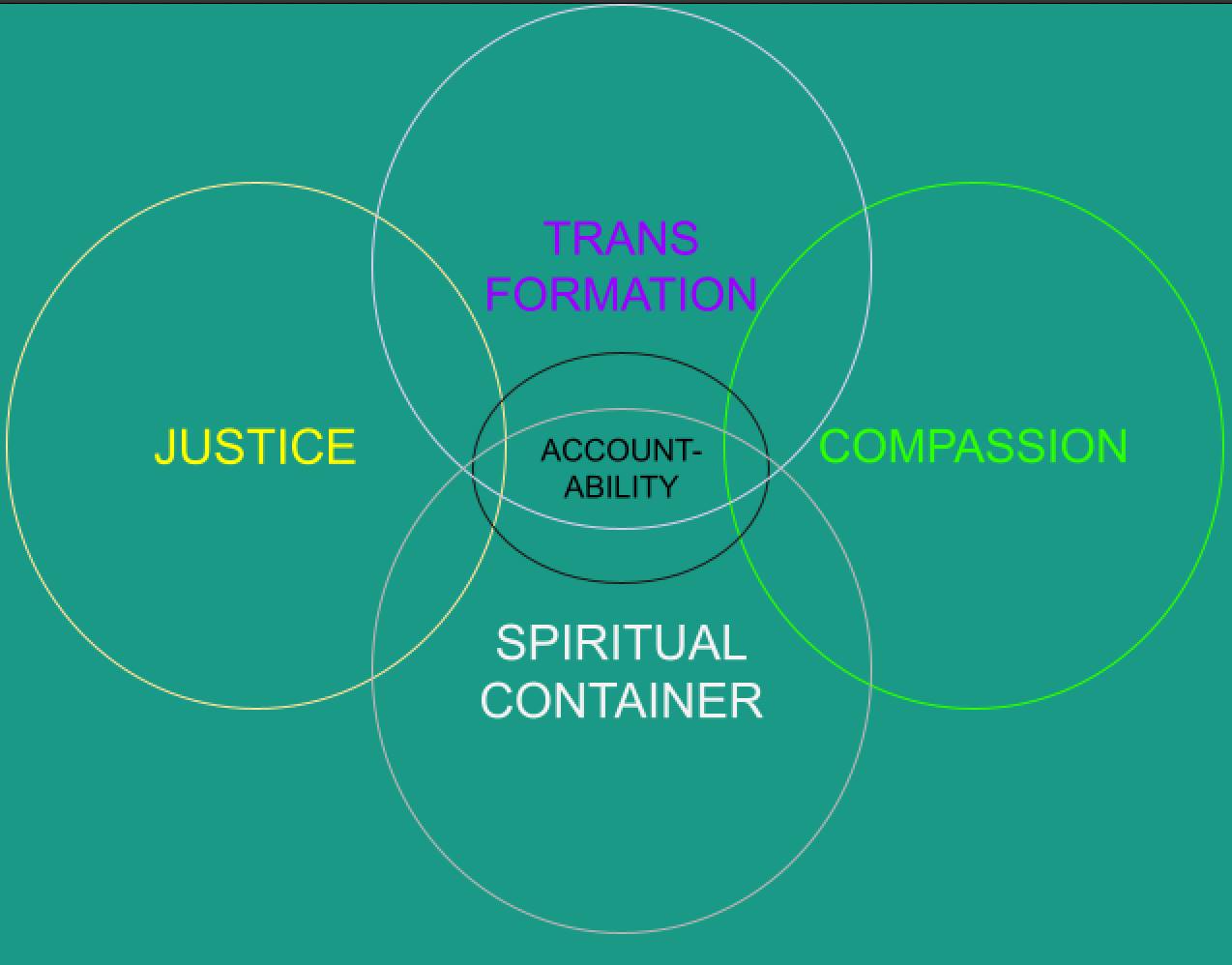
Rev Felicia used this image to frame her talk. It looks both nifty and complicated—and it is. Okay, it’s not rocket science, per se, but it is a schematic for terra-forming—for remaking the world—from inside ourselves all the way to our communities, social systems, and how we situate ourselves in the world. So, yeah, complicated. Yet simple. Let’s go.

Caveat: I am NOT Rev. I have a gift of words. Not so much the bright eyes, big smile, hearty laugh, or nails to die for. That’s Rev. Well, that plus a heart of gold, a mind of steel, and passion to change the world. Me: words. Still, words are cool.

Transformation: that’s our goal. Sure, our ultimate “goal” is a world where all (from eco-systems and creatures to individuals and communities) have the opportunity to flourish, but there is no 30-day or 30-year plan to achieve that goal. We may never “reach” it (in fact—spoiler alert—it’s quite possible things will get worse). So our practical goal is to be as fully engaged in transformational work as we can be. To be actively creating pockets of authentic community here and now, to be fostering change in ourselves and others, to be undoing the biases and the systems that drives injustice today.

One of the early books of feminist theology was titled The Journey is Home—because when you’re engaged in work that will last a lifetime and more, you want to make sure that the work itself is sustainable and hospitable to life (after all, YOU will be spending your life there!). Thus, while transformation surely does have moments of intense focus and hard work, it also has moments of respite and joy. And in both moments we are fulfilling our vocation: to be fully human in ways that are life-giving: moving us closer to justice and experiencing glimmers of joy. That’s transformation. But how do we engage that work?

By practicing Justice and Compassion. These twin energies function like the engine of our work. Think of a bicycle. How do we get the wheels to turn and carry us forward? We pedal. We get the most energy when we use both pedals. You can bike using just one pedal, but it’s pretty awkward, hardly the most efficient way to generate energy. We have two pedals; we’ll get the most energy if we use them both.

Most of us are either right-handed or left-handed. In a similar way, when it comes to these pedals, most of us have a “preferred” pedal to lead with. These aren’t hard and fast descriptions, but you can think of Justice as involving fairness, principles, intellect, logic. etc. And Compassion as involving empathy, solidarity, feeling, intuition, etc. In our society we also tend to slot Justice as a masculine virtue and Compassion as a feminine virtue, (and so we give Justice the last word), but that’s bullshit.

Here “bullshit” is fancy theological jargon for naming when society-culture-religion makes it harder for us to be our most whole and most powerful selves. The simple truth is that most of us (whether by temperament, interest, encouragement, or training) lean into the work of Transformation more easily from Justice or from Compassion. It doesn’t really matter—in fact, it’s probably wise to trust your preferences and act from your strengths … while also working to gain skill/ability with the other pedal. They both drive the bike, and we’re most balanced when we use both pedals—even as we tend to push harder with our own preferred pedal.

The actual practice of Justice and Compassion happens in our individual and communal lives. Connecting to BLM events, labor causes, or peace work are all examples of Justice that I’ve seen on the ROL FB page. Doing midweek seva check-ins or lifting others up in prayer at service are examples of Compassion. There are countless opportunities for Justice or Compassion, and while they can sometimes seem mundane—almost too ordinary—don’t take them for granted. These are perhaps the primary places where the energy that powers the cosmos intersects with human choice. When you “dabble” in Justice or Compassion, it’s like dipping your toe in a river racing with whitewater rapids. You are “channeling” the very Hope of the Highest and there’s no telling where it may carry you next.

Which is why having a Spiritual Container is so important. It’s about honoring the sheer power of the energy that we’re capable of hosting. Get this: when we practice Justice or Compassion they move like sacred energy pulsing through our attitudes and actions and flowing out into the world. That is some serious shit going down. Through us. As CS Lewis notes in his Narnia Chronicles, Sheer Goodness is absolutely GOOD, but it is absolutely not safe or tame.

Imagine being a turbine used to generate energy on a river. The turbine only works if it’s strong enough, not to stop the water, but to draw energy from the water as it runs through it. In order for us to channel the universe’s energy into this world as Justice and Compassion we need to have strong Spiritual Containers.

We fashion them in a variety of ways. Lighting a candle at the start of service to signify that this space-time is set aside for holiness. Breathing to slow ourselves down and bring ourselves into the moment. Attending to our land acknowledgement, path acknowledgement, and mission are all small but powerful ways to weave a Spiritual Container. They “rehearse” the radical openness and humility that helps us safely carry the power of sacred energy. Establishing a rhythm of inward work like meditation, prayer, self-reflection, therapy, art, or music in our daily lives helps restore our inner strength and invite its roots to go deep. Just as importantly, having connections with like-minded people, persons with whom we can communicate with honesty and respect help ensure that we never imagine we’re on our own. This is holy work. It’s heavy work. AND it’s communal work. The strongest Spiritual Containers bear the marks of many hands and hearts.

Finally, Accountability. If our Spiritual Container is what “channels” the energy of Justice and Compassion toward Transformation, then Accountability is the crucial practice of seeking and welcoming input from beyond ourselves to help keep us “on target.”

We all carry crap in our lives: wounds, baggage, biases, bad habits. We can probably all name some of our crap. Odds are, our friends could name even more of our crap. Because some (most!) of it, we’re not even aware of. No surprise there. Even the wounds that knocked us several ways sideways likely left scars and triggers that we don’t know about. And the nasty thing about systems (white supremacy, patriarchy, homophobia, xenophobia, capitalism, nationalism, consumerism) is that they WORK precisely by shaping us in ways we’re unaware of. And we were born into those systems. They’ve had easier access to us than the fluoride in our drinking water.

Which is why Accountability is NOT about feeling guilty or like failures. It’s about being grateful when someone else helps us clear away the crap that stops us from being our best selves. Granted, there are some who do that graciously and some who do it with an edge (usually because our crap has caused them pain). No matter. Accountability—especially when our Spiritual Container has been well-fashioned—is a gift. It helps ensure that our best intentions to bring Justice and Compassion to bear in the world actually do that. We need strong selves and humble egos to do the work of Transformation. Accountability is where we prune back our egos so that our strong selves can also be our best selves.

There you have it, a whirlwind recap of sparkling conversation Margaret and I had after last week’s service. There’s probably a few points in here where Rev winced because I didn’t quite catch her meaning, but I’m betting there’s also a few places where her eyes lit up, her smile blossomed, and maybe she even clicked those nails that scare me. Hopefully this little serving of leftovers gave you something to nosh on while ROL takes a week off; maybe it even sharpens your appetite for some fresh food when we gather again in a week.

Bon appétit!

* * *

David Weiss is a theologian, writer, poet and hymnist, doing “public theology” around climate crisis, sexuality, justice, diversity, and peace. Reach him at drw59mn@gmail.com. Read more at www.davidrweiss.com where he blogs under the theme, “Full Frontal Faith: Erring on the Edge of Honest.” Support him in writing Community Supported Theology at www.patreon.com/fullfrontalfaith.

Braiding Sweetgrass … with Jesus – #2

Braiding Sweetgrass … with Jesus – #2
David R. Weiss – July 1, 2021

This is the second in a series of occasional reflections as I make my way through Robin Wall Kimmerer’s Braiding Sweetgrass (Milkweed Editions, 2013). Kimmerer, a member of the Citizen Potawatomi Nation and a botanist—not to mention a wonderful writer—weaves together story and wisdom and science, braiding them … like sweetgrass. As I explained in my first piece, my intent is neither to critique nor to co-opt her work, but to place it in fruitful conversation with my own Christian tradition—hence, one more strand in the braid. So this is me … braiding sweetgrass … with Jesus.

Eve … and the Apocalypse (Braiding, pages 7-9)

Sometimes it takes someone outside your own family to help you see its internal dynamics in a fresh light. One of the international high school students we hosted told us later that his experience in our home had invited him to rethink what was possible for “family.” We sort of took for granted how family life should be, but coming from his less healthy family experience he found his months in our home transformative. And by naming that to us we came to see the health of our home with new clarity. On the other hand, I once dated a young woman who I quickly discovered, as I spent time around her family, was the butt of every family story. Relentlessly. When I raised this to her, she felt driven to excuse it: “It’s just the way they try to show they love me.” She was so embedded in her story that it was threatening to see the way it undermined her own sense of self.

Kimmerer observes a similar hard truth for us. If we can listen. She notes how Skywoman is revered as a wise teacher and a model for how to live in harmony with the world into which she fell … while our Eve became a focal point of contempt and her story sets alienation—even banishment—at the heart of human experience. It’s hard to assess the damage done to women by this story. As much as patriarchy has dominated many cultures, the ascendancy of Christian patriarchy, enshrined not only in belief and culture, but also in law, has promulgated about as much suffering as any other twist of fate. Except one.

The larger theme in Eve’s tale (larger even than the yawning gender injustice) is the cosmological theme that sets the whole of humanity at odds with the (rest of!) the natural world … a world into which we are exquisitely and inextricably woven. Over the last two thousand years (the tale is older by far, but it’s the Christian spin on this tale that’s been so dangerous) this theme has offered the “ideological infrastructure” necessary to plunder the planet, to commit unimaginable atrocities against our fellow creatures, to reduce the living world to “resources,” and to light the fuse for a climate apocalypse that now seems all but certain to decimate half the life on this planet (www.phys.org/news/2021-06-climate-impacts-nature.html). HALF THE LIFE ON THIS PLANET. A horror that, should it come to pass, will provide a near insurmountable argument against the presence of a God who is either loving or just—all the more so should we be among the species to survive.

Yes, this story, Eve’s story, is more complex than simply these two themes. There are strands of holy truth as well as bits of hard-won wisdom harbored within this tale: God’s nearness to creation; our being “inspired” dirt; our kinship with creatures; tending the garden as human vocation; honest wrestling with the hard truths of enmity and mortality. But for generations we have allowed these two themes (gender inequality and creation’s otherness) to set the tone for a now global worldview that threatens the world itself. Which is why Kimmerer’s outsider observations needs to be amplified by those of us who claim Eve’s story as our own. This tale has been used to give aid and comfort to the enemies of Earth. It has been told in ways treasonous to creation itself.

Worse, this telling has two thousand years of inertia behind it. And if we do not re-write and re-right it in the next two decades—and do so not simply on paper, but in our hearts and lives as well—Eve’s tale will become the literary preface to a biological apocalypse. Stories matter. If we want Eve to truly be “the mother of all living” it’s time to tell her story very differently. Lest we make her the mother of all dead.

* * *

David Weiss is a theologian, writer, poet and hymnist, doing “public theology” around climate crisis, sexuality, justice, diversity, and peace. Reach him at drw59mn@gmail.com. Read more at www.davidrweiss.com where he blogs under the theme, “Full Frontal Faith: Erring on the Edge of Honest.” Support him in writing Community SupportedTheology at www.patreon.com/fullfrontalfaith.